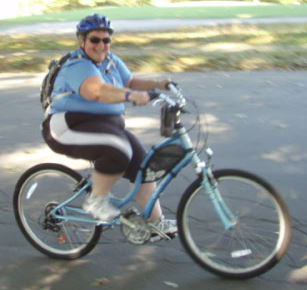
It's Friday today, almost the end of my first week here at Green Mountain, and I am reminded of something I figured out a long time ago. If you want instant gratification, a constant sense of progress and achievement, there is no better endeavor than strength training.
Most people with weight management issues focus exclusively on the scale, which is a recipe (pardon the food reference) for disaster. We have absolutely no control over how our body metabolizes what we feed it, or the schedule by which it eliminates waste products and stores or utilizes fat. We do have control of our actions. So, right off the bat (pardon the exercise reference), physical activity represents a much better arena in which to measure progress than what we eat. And while aerobic activities can also provide a steady sense of accomplishment, there is nothing like feeling your muscles get stronger and more flexible by the day, doing an addition repetition or going up in weight, or simply feeling better able to do those reps without huffing and puffing and turning purple.
For the first three years after my first visit to Green Mountain, I embraced strength training almost religiously, clinging to it when everything else was falling apart. There were good reasons for this. For one thing, I had learned that strength training is just about the only way a short, middle-aged female can increase her metabolic rate. For another, I can usually manage strength training even when my asthma and/or orthopedic issues make cardiovascular effort too difficult or painful. So I did my alternating upper- and lower-body conditioning routines every morning almost without fail, despite various kinds of tendonitis and a medication adjustment that left me with 8 weeks of intense fatigue until my body got used to it.
Sometimes it would take me all day to complete the lower body routine, as I could manage only about one exercise per hour and would lie on the floor staring upside down out the window at the palm tree next door (this was in Hawaii) until I could muster up the will and the energy to go on to the next muscle group. It would take me several hours, but I would do it. I felt stronger, I was fitting better into clothes, and I felt really good about myself.
Then I suddenly found myself unable to bridge whatever the hurdles were, and I began dreading strength training with an intense, consuming dread that left me paralyzed. Every morning I would dress in my fetching exercise attire and mope around the house, feeling as though I couldn't do anything else until I completed my strength training for the day, yet not being able to bring myself to do it. This meant, of course, that I never got anything at all done, which increased my stress level and flooded my brain with negative self-talk, so that the next day I dreaded the strength training even more. And on and on and on.
Since my major illness last fall, I have had no problem getting to be more active; I rely on my joy in bicycling to motivate me to ride as often as I can. But I've been waiting, in vain, for similar intrinsic motivation to strike me regarding the strength training piece. On the other hand, what led me to sign up for these two weeks at Green Mountain was feeling so weakened at my core and yearning for the feeling that exercising my muscles gives me.
I am happy to report that after 5 days, I feel like a different person. I still find the exercises, especially lower body, hard and occasional uncomfortable, but I'm starting to feel a kind of delight in doing them, as they allow me to feel my body getting stronger by the day. By the time I leave next Saturday, this ember of pleasure will, I hope, have been fanned into a flame of enthusiasm so that I can keep things up after I get home, even while traveling. Perhaps that is all that intrinsic motivation needs to be. Perhaps one day soon I will long to do quad lifts and biceps curls the way I now long to be on my bike.
A hui hou.
Friday, April 30, 2010

Thursday, April 29, 2010
Knitting Up the Ravelled Sleeve
I never used to have sleep problems, not that I remember, anyway. But when I developed asthma, in my thirties, for about a year and half I was up till 3 or 4 in the morning coughing and hacking, until we finally hit on the right regimen to manage it. Then after that, I was up till 3 or 4 in the morning because I was taking theophylline, which is in the same pharmaceutical family as caffeine, with similar effects. Then I became a gigging musician who frequently had to drive home after midnight; while I have the welcome ability to stay awake while driving, even when I'm tired, when I get home from such a drive it takes me a long time to reverse the effects of whatever it was that allows me to stay alert. Then came menopause, and nearly 3 years of springing totally wide awake at 3am, no matter what time I went to sleep. Now, my ability to fall asleep is frequently compromised by aches and pains and gout as well as respiratory infections, so all in all, I do not have an easy relationship with Morpheus.
But that's not the only problem.
I've always been a secret eater, much to my great shame. I remember the most humiliating moment of my young life being when the cleaning lady found a paper bag with empty cookie boxes in my closet and told my parents, who took away my allowance and made me come right home after school so I couldn't buy extraneous food. In my adult life, I've done most of my eating for other than hunger reasons late at night, waiting till everyone else in the house is asleep. This frequently means staying up well past the point at which my body wants to go to sleep.
Over the past five years, as I've dealt with a lot of the underlying issues that have kept me from successful weight management, my urge to eat inappropriately has lessened a great deal, and as a result I've been able to sleep much better and more easily. But there are times still when I get into bed at a very reasonable time, feeling tired and ready to sleep, but the minute I hit the mattress, my knee and my ankle and my toes all start to hurt, and/or I start coughing, and within minutes I'm wide awake and feeling anxious and completely stressed out about not being able to fall asleep. Meditating and listening to soothing music don't help, nor does focusing on my breath, so I end up feeling like a rotisserie chicken until I finally feel compelled to get out of bed and head for the kitchen. Food still soothes, most of the time, and quiets something in my brain (something about seratonin) so that I can finally fall asleep. If it doesn't soothe, it helps pass the time until I get so tired I can't help but fall asleep.
This is obviously not an optimal situation. Recent research has suggested that lack of sufficient sleep can contribute to weight gain (or failure to lose weight) through a number of mechanisms. Sleep deprivation can also contribute to feelings of stress, and hamper one's ability to problem solve or be mindful. And last night I got first-hand knowledge of another benefit of a decent night's sleep.
I've been plagued, since I arrived on Sunday, with a lot of ankle pain and pain in my knee, presumably the result of being much more active, especially on stairs. I've also had some break-out gout pain in my big toes, and some asthma. The net result is that when I lie down in bed, everything starts to hurt. And, as I described above, I start to agitate about not being able to sleep or wake up early and can't fall back to sleep, etc. etc.
Of course, since I have been doing a lot of strength training since I've been here, I had acquired a whole lot more aches and pains and stiffness. In fact, by dinnertime last night, I could barely get up out of my chair to hobble back to my room. So when bedtime came around, I decided to take a tramalol, which is one of the few painkillers I can take that doesn't interact adversely with my blood pressure. I usually take it only when I am in such discomfort that I can't sleep, and it seems to allow my muscles all to relax. Consequently, I slept really well, and this morning it was like magic -- all the muscle aches and pains were gone. Better living through chemistry!
Clearly, I need to do something about my difficulties with sleep. While I don't see a clear way ahead at this particular moment, I am confident that with the help of the folks here and my own prodigious problem-solving skills, I'll figure it out eventually. Until then, I have to do whatever I can to keep the sleeve of care from ravelling further.
A hui hou.
But that's not the only problem.
I've always been a secret eater, much to my great shame. I remember the most humiliating moment of my young life being when the cleaning lady found a paper bag with empty cookie boxes in my closet and told my parents, who took away my allowance and made me come right home after school so I couldn't buy extraneous food. In my adult life, I've done most of my eating for other than hunger reasons late at night, waiting till everyone else in the house is asleep. This frequently means staying up well past the point at which my body wants to go to sleep.
Over the past five years, as I've dealt with a lot of the underlying issues that have kept me from successful weight management, my urge to eat inappropriately has lessened a great deal, and as a result I've been able to sleep much better and more easily. But there are times still when I get into bed at a very reasonable time, feeling tired and ready to sleep, but the minute I hit the mattress, my knee and my ankle and my toes all start to hurt, and/or I start coughing, and within minutes I'm wide awake and feeling anxious and completely stressed out about not being able to fall asleep. Meditating and listening to soothing music don't help, nor does focusing on my breath, so I end up feeling like a rotisserie chicken until I finally feel compelled to get out of bed and head for the kitchen. Food still soothes, most of the time, and quiets something in my brain (something about seratonin) so that I can finally fall asleep. If it doesn't soothe, it helps pass the time until I get so tired I can't help but fall asleep.
This is obviously not an optimal situation. Recent research has suggested that lack of sufficient sleep can contribute to weight gain (or failure to lose weight) through a number of mechanisms. Sleep deprivation can also contribute to feelings of stress, and hamper one's ability to problem solve or be mindful. And last night I got first-hand knowledge of another benefit of a decent night's sleep.
I've been plagued, since I arrived on Sunday, with a lot of ankle pain and pain in my knee, presumably the result of being much more active, especially on stairs. I've also had some break-out gout pain in my big toes, and some asthma. The net result is that when I lie down in bed, everything starts to hurt. And, as I described above, I start to agitate about not being able to sleep or wake up early and can't fall back to sleep, etc. etc.
Of course, since I have been doing a lot of strength training since I've been here, I had acquired a whole lot more aches and pains and stiffness. In fact, by dinnertime last night, I could barely get up out of my chair to hobble back to my room. So when bedtime came around, I decided to take a tramalol, which is one of the few painkillers I can take that doesn't interact adversely with my blood pressure. I usually take it only when I am in such discomfort that I can't sleep, and it seems to allow my muscles all to relax. Consequently, I slept really well, and this morning it was like magic -- all the muscle aches and pains were gone. Better living through chemistry!
Clearly, I need to do something about my difficulties with sleep. While I don't see a clear way ahead at this particular moment, I am confident that with the help of the folks here and my own prodigious problem-solving skills, I'll figure it out eventually. Until then, I have to do whatever I can to keep the sleeve of care from ravelling further.
A hui hou.
Tuesday, April 27, 2010
Plan B and Beyond
Here I am, back at Green Mountain at Fox Run, which has truly become my home away from home over the past four and a half years. I could go on and on about how wonderful and transformative the program is, how knowledgeable and compassionate the staff all are, the delicious meals and the beautiful surroundings, and maybe I will in another post. But today I want to focus on one aspect of the Green Mountain experience that I most appreciate, which is the empowering attitude of always finding a way to deal with (and get around) impediments.
One of the main reasons I came here in the first place, in September 2005, was that the program literature promised a safe environment in which women with physical challenges could learn how to become active without hurting themselves. This was essential for me, given my old knee injury and frequent tendonitis in my foot, not to mention my asthma. I figured I could try out all kinds of physical activity and find ones that I didn't hate too much, at the very least, and learn to do them without injuring myself further.
I was a total tomboy as a child, and all through college remained quite physically active despite not being the fastest runner. I was great at softball (having spent my childhood playing catch in the backyard), could swish baskets on demand, rode my bike all over the place, and do just about any other sport involving good hand-eye coordination. Yes, I was overweight, but I was strong and loved moving. Then when I was in England I was following a public footpath home from a Slimming Club meeting (just another example of diets being bad for your health!) and ended up going over a wall that was twice as far down on the other side, landing in a deserted monastery garden and tearing the cartilage in my left knee. Back then no one even said the words "physical therapy," so I was left with a chronically weak joint that would get reinjured just about every time I played tennis or ran across the street or even landed funny on that leg. Ten years later I developed asthma, and that really put an end to my active life as I had known it.
By the time I arrived at Green Mountain, in addition to living pretty much entirely in my head (as dealing with my body was no fun at all), I had also become afraid to move, especially if it involved raising a foot off the floor. Walking was manageable, but dancing was out of the question, and going up and down stairs was the bane of my life.
What I discovered when I started the program here was that being physically active is the closest thing to a magic bullet for all sorts of issues, not just weight management, and that there is always a way to exercise all the muscles of the body, including the heart (ie, aerobic activity), even if you are orthopedically or medically challenged. I also learned that while being active may be hard, at first, if it hurts that means you aren't doing the activity correctly or are doing too much of it.
LynnAnn Covell, who was fitness director at that time and currently manages the lifestyle coaching program here, is one of the most inspirational people I have ever encountered, and one of the first things she said to my class of Green Mountain newbies was that if Plan A didn't work for us, she would come up with Plan B, and if that still didn't work, she would come up with plans C through Z, until she found a way for each of us to exercise comfortably and in a way that would allow us to become more fit and more comfortable in ourselves. And I've learned that she was telling the truth. If you can't do quad lifts on the floor, you can do them standing up or in a chair or on a fitball or in bed or in the pool. If you can't walk, you can swim or bounce on a fitball or ride a bike. If you can't dance on your feet, you can dance sitting in a chair or on a fitball and feel the joy in moving with the music.
This approach works for other aspects of life as well. If you can't meditate on your own, you can listen to a recording of affirmations, or do some guided imagery, or a walking meditation or simply take a mindful walk in a beautiful place. If you can't bear the thought of giving up eating in front of the television you can eat a meal there and set a timer to tell you when food needs to go back to the kitchen so you don't end up eating mindlessly for hours. If you can't make a healthy lunch every day you can cook a whole bunch of things on the weekend or buy prepared foods that fit into how you want to eat or bring a stock of such foods into your work environment or figure out how to make healthier restaurant choices. There is no one perfect answer, and searching for it can get in the way of finding a functional solution.
The trick to making this work is not letting disappointment and frustration at being unable to carry out Plan A get in the way of recognizing plan B and beyond.
A hui hou.
One of the main reasons I came here in the first place, in September 2005, was that the program literature promised a safe environment in which women with physical challenges could learn how to become active without hurting themselves. This was essential for me, given my old knee injury and frequent tendonitis in my foot, not to mention my asthma. I figured I could try out all kinds of physical activity and find ones that I didn't hate too much, at the very least, and learn to do them without injuring myself further.
I was a total tomboy as a child, and all through college remained quite physically active despite not being the fastest runner. I was great at softball (having spent my childhood playing catch in the backyard), could swish baskets on demand, rode my bike all over the place, and do just about any other sport involving good hand-eye coordination. Yes, I was overweight, but I was strong and loved moving. Then when I was in England I was following a public footpath home from a Slimming Club meeting (just another example of diets being bad for your health!) and ended up going over a wall that was twice as far down on the other side, landing in a deserted monastery garden and tearing the cartilage in my left knee. Back then no one even said the words "physical therapy," so I was left with a chronically weak joint that would get reinjured just about every time I played tennis or ran across the street or even landed funny on that leg. Ten years later I developed asthma, and that really put an end to my active life as I had known it.
By the time I arrived at Green Mountain, in addition to living pretty much entirely in my head (as dealing with my body was no fun at all), I had also become afraid to move, especially if it involved raising a foot off the floor. Walking was manageable, but dancing was out of the question, and going up and down stairs was the bane of my life.
What I discovered when I started the program here was that being physically active is the closest thing to a magic bullet for all sorts of issues, not just weight management, and that there is always a way to exercise all the muscles of the body, including the heart (ie, aerobic activity), even if you are orthopedically or medically challenged. I also learned that while being active may be hard, at first, if it hurts that means you aren't doing the activity correctly or are doing too much of it.
LynnAnn Covell, who was fitness director at that time and currently manages the lifestyle coaching program here, is one of the most inspirational people I have ever encountered, and one of the first things she said to my class of Green Mountain newbies was that if Plan A didn't work for us, she would come up with Plan B, and if that still didn't work, she would come up with plans C through Z, until she found a way for each of us to exercise comfortably and in a way that would allow us to become more fit and more comfortable in ourselves. And I've learned that she was telling the truth. If you can't do quad lifts on the floor, you can do them standing up or in a chair or on a fitball or in bed or in the pool. If you can't walk, you can swim or bounce on a fitball or ride a bike. If you can't dance on your feet, you can dance sitting in a chair or on a fitball and feel the joy in moving with the music.
This approach works for other aspects of life as well. If you can't meditate on your own, you can listen to a recording of affirmations, or do some guided imagery, or a walking meditation or simply take a mindful walk in a beautiful place. If you can't bear the thought of giving up eating in front of the television you can eat a meal there and set a timer to tell you when food needs to go back to the kitchen so you don't end up eating mindlessly for hours. If you can't make a healthy lunch every day you can cook a whole bunch of things on the weekend or buy prepared foods that fit into how you want to eat or bring a stock of such foods into your work environment or figure out how to make healthier restaurant choices. There is no one perfect answer, and searching for it can get in the way of finding a functional solution.
The trick to making this work is not letting disappointment and frustration at being unable to carry out Plan A get in the way of recognizing plan B and beyond.
A hui hou.
Saturday, April 24, 2010
Finding My Heart Space
Part of my journey to increased calm and healthfulness has involved learning to meditate. I started with guided imagery as part of the Green Mountain at Fox Run program, and then started doing actual meditation when I began phone coaching sessions with one of the behavioral specialists there. Being the perfectionist that I was/am, I spent much of the first weeks trying to figure out if I was doing it right, and really concerned that I wasn't. Eventually I got over that and became much more comfortable with the notion that meditation is a practice, in the same sense of that word as I am familiar with from my musical life; there's no way to be perfect, but the repetition makes the whole process occur with a greater sense of ease.
Then my coach started talking about getting into my "heart space," breathing into it, feeling and acting from it, and I was lost. I had absolutely no idea what she was talking about. Three years later, I still didn't, not really, but had made enough progress so that I was no longer worrying about why I was "failing" at this piece of my task. I guess that eventually I started to believe that I was probably there, whatever that meant, but simply unable to feel what that meant.
Fast forward to our time in San Francisco, where at Carol's meeting she learned about a company that makes a product called "emWave" -- a combination of software and sensor that helps train you to achieve what they refer to as "coherence," a synchronization of your heart rate with your autonomic nervous system. This sounded intriguing, so we saw a demonstration of the desktop computer program and promptly bought a system to try at home. The program suggests that you "focus your attention in the area of the heart and pretend you are breathing in and out through the heart area." Since I had never been able to do that in any reliable way, I thought using the software might help me attain that connection, which seems to be pretty important to inner peace.
I installed the software when we got home and have now had several sessions. I think this is just the tool that I need. I'll try to describe what a session entails.
After opening the program, you attach a sensor to your earlobe; the other end plugs into a little unit that plugs into a USB port. It looks a lot like a thumb drive. Then you press start and your session begins. For the first 30 seconds or so, the unit calibrates your heart rate, and you can check whether the sensor is well-placed to get a good signal. Once it has calibrated, you start hearing a chiming every five seconds to tell you how your state of coherence is. Here's a rather fuzzy screen shot of a basic session:
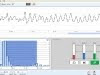
The squiggle along the top represents your heart rhythm. You are shooting for a smooth and regular pattern rather than something that looks like High Sierra. The three bars in the lower right are the three levels of coherence: red is low, blue is medium and green is high. The greater percentage of the time you spend is blue or green, the more relaxed and centered you are.
The default has a low bonging for low coherence, a medium chiming for medium coherence, and a spritely high ringing for high coherence. I found that I wasn't budging off the low level and thought it might be because I find the low bonging quite restful, so I reversed the low and high sounds assigned by the program and have had much better luck. It's very helpful to have the immediate feedback, and it's getting easier for me to bring myself back out of the low level by focusing on my heart space, so I guess I've already done better at finding it than I ever did before.
The program also has interesting visualizations to help you stay focused and motivated, as well as three games that you control by keeping yourself in the more desirable states of coherence. I'm looking forward to spending more time with these as I practice centering myself with this interesting and helpful tool. Maybe future posts will actually originate from my heart space. One can but hope.
A hui hou.
Then my coach started talking about getting into my "heart space," breathing into it, feeling and acting from it, and I was lost. I had absolutely no idea what she was talking about. Three years later, I still didn't, not really, but had made enough progress so that I was no longer worrying about why I was "failing" at this piece of my task. I guess that eventually I started to believe that I was probably there, whatever that meant, but simply unable to feel what that meant.
Fast forward to our time in San Francisco, where at Carol's meeting she learned about a company that makes a product called "emWave" -- a combination of software and sensor that helps train you to achieve what they refer to as "coherence," a synchronization of your heart rate with your autonomic nervous system. This sounded intriguing, so we saw a demonstration of the desktop computer program and promptly bought a system to try at home. The program suggests that you "focus your attention in the area of the heart and pretend you are breathing in and out through the heart area." Since I had never been able to do that in any reliable way, I thought using the software might help me attain that connection, which seems to be pretty important to inner peace.
I installed the software when we got home and have now had several sessions. I think this is just the tool that I need. I'll try to describe what a session entails.
After opening the program, you attach a sensor to your earlobe; the other end plugs into a little unit that plugs into a USB port. It looks a lot like a thumb drive. Then you press start and your session begins. For the first 30 seconds or so, the unit calibrates your heart rate, and you can check whether the sensor is well-placed to get a good signal. Once it has calibrated, you start hearing a chiming every five seconds to tell you how your state of coherence is. Here's a rather fuzzy screen shot of a basic session:

The squiggle along the top represents your heart rhythm. You are shooting for a smooth and regular pattern rather than something that looks like High Sierra. The three bars in the lower right are the three levels of coherence: red is low, blue is medium and green is high. The greater percentage of the time you spend is blue or green, the more relaxed and centered you are.
The default has a low bonging for low coherence, a medium chiming for medium coherence, and a spritely high ringing for high coherence. I found that I wasn't budging off the low level and thought it might be because I find the low bonging quite restful, so I reversed the low and high sounds assigned by the program and have had much better luck. It's very helpful to have the immediate feedback, and it's getting easier for me to bring myself back out of the low level by focusing on my heart space, so I guess I've already done better at finding it than I ever did before.
The program also has interesting visualizations to help you stay focused and motivated, as well as three games that you control by keeping yourself in the more desirable states of coherence. I'm looking forward to spending more time with these as I practice centering myself with this interesting and helpful tool. Maybe future posts will actually originate from my heart space. One can but hope.
A hui hou.
Friday, April 23, 2010
Getting Ready for the Next Round
After our intense, exhausting time in San Francisco, capped by a seriously uncomfortable overnight flight home to Boston, I am now getting ready to go back to Green Mountain at Fox Run for two weeks, starting Sunday. The part of me that has to unpack and repack and get organized is feeling a little overwhelmed, but the part of me that is yearning to be healthier is excited and eager.
 I love Green Mountain. I love the vastness and solidity of Okemo Mountain, which watches over our days there. I love the staff, who have become practically family after all the time I've spent there, and I love the other women who take part in the program. Being able to spend the bulk of my days taking care of myself and making my health my top priority is a wonderful gift, and one that I appreciate deeply.
It is a place where mindfulness comes easily. The clarity and quiet of the Vermont air form a magnificent backdrop for the act of paying attention. Sometimes, when I am meditating at home, I can hear my feet crunching on the track as I walk my laps, a gentle, rhythmic sound that I find enormously grounding. I look forward, always, to the wonderful meals so lovingly prepared by chefs Jon and Lisa, who are so generous in sharing their knowledge with us in the hopes that we can learn to cook mindfully and with joy. If I want quiet and solitude, I can spend hours by myself, coming out of my room only for the occasional class and meals. If I want company, there is always someone interesting to talk to or to provide a hug, an encouraging word or a little commiseration.
I'm looking forward to my time there as an oasis in a very busy spring. I'm just above the weight where I feel comfortable in my skin, and the two weeks in Vermont should get me back to a more tolerable level, in addition to helping me figure out what my next focus needs to be. I hope that two weeks of regularly engaging in strength training will help make that a routine again, and that two weeks of upping my cardio and walking (of necessity) up and down stairs many times a day will make moving a little easier. And finally, I am planning to use my various physical therapy aids regularly, so that my ankle pain will recede to a more manageable level.
Of course, the dangers of having expectations are always lurking. If I get there and have a flare-up of orthopedic issues or asthma, I won't be able to do all the activities I've been imagining, and that will be disappointing. But I've never been there without learning the next thing I needed to work on, so I am confident that this will be a good use of my time, whatever I take away from it.
I'm also planning to try to post every day while I'm at Green Mountain, so that I can share what I learn and help solidify it in my mind.
A hui hou.

It is a place where mindfulness comes easily. The clarity and quiet of the Vermont air form a magnificent backdrop for the act of paying attention. Sometimes, when I am meditating at home, I can hear my feet crunching on the track as I walk my laps, a gentle, rhythmic sound that I find enormously grounding. I look forward, always, to the wonderful meals so lovingly prepared by chefs Jon and Lisa, who are so generous in sharing their knowledge with us in the hopes that we can learn to cook mindfully and with joy. If I want quiet and solitude, I can spend hours by myself, coming out of my room only for the occasional class and meals. If I want company, there is always someone interesting to talk to or to provide a hug, an encouraging word or a little commiseration.
I'm looking forward to my time there as an oasis in a very busy spring. I'm just above the weight where I feel comfortable in my skin, and the two weeks in Vermont should get me back to a more tolerable level, in addition to helping me figure out what my next focus needs to be. I hope that two weeks of regularly engaging in strength training will help make that a routine again, and that two weeks of upping my cardio and walking (of necessity) up and down stairs many times a day will make moving a little easier. And finally, I am planning to use my various physical therapy aids regularly, so that my ankle pain will recede to a more manageable level.
Of course, the dangers of having expectations are always lurking. If I get there and have a flare-up of orthopedic issues or asthma, I won't be able to do all the activities I've been imagining, and that will be disappointing. But I've never been there without learning the next thing I needed to work on, so I am confident that this will be a good use of my time, whatever I take away from it.
I'm also planning to try to post every day while I'm at Green Mountain, so that I can share what I learn and help solidify it in my mind.
A hui hou.
Sunday, April 18, 2010
I Am What I Am
Have you ever been sitting in an overheated room or car or airplane wearing too many layers? And when you get to where you can finally shed the excess, have you ripped off the heavy, damp garmets and exposed your skin to the cool air and felt so much lighter, and so relieved to be comfortable again? I had that experience just last night, walking back to our hotel from a wonderful dinner. When I got to the room, I ripped off my sweater and my shirt and flopped down on the bed, experiencing, for just a moment, delicious relief.
Then it occurred to me that I craved an even deeper level of relief. I wished I could unzip my skin and peel off the extra layers of me the way I removed my clothes.
Being here in San Francisco, where we need to walk everywhere, is a challenging experience. When I'm at home, I can ride my bike, which doesn't hurt or stress my body overmuch. Here, I have to walk, which, in addition to the strain of moving my heavy body through space, also aggravates my ankle problem and until this morning my gout as well. So I'm not exactly a happy camper walking around, as much as I may enjoy being outside in a beautiful, interesting place. The night we arrived, as I forced myself to walk along to dinner and back, I was feeling exhausted (it was 3am, body time) and disheartened by how hard it felt, but from somewhere deep inside I mustered up the will to mutter to Carol, "I am what I am."
"I Am What I Am" is the name of a very sweet song by Roy Sakuma, a teacher and ukulele advocate in Hawaii, who wrote it to inspire and encourage people, especially kids, to love themselves as they are. I first came across the song this past winter in Aunty Marjie's ukulele class, where Aunty Marjie shared how she feels that the song is an anthem for her as she joyously walks her own path in life.
When I said that to Carol the other night, she very sweetly replied, "And I love what you are." I wasn't feeling love for myself at that moment. At least not for my physical self. Yet if I can't love my body and treat it with compassion, I won't be able to do what I need to get healthy. It's a conundrum.
And so today, I'll go out into the warm sunshine again and walk the city, wishing I could be flying along on my bike, trying to make peace with the effort and the discomfort and the struggle that are so much a part of what I am right now.
I am what I am. Right now. In this moment.
A hui hou.
Then it occurred to me that I craved an even deeper level of relief. I wished I could unzip my skin and peel off the extra layers of me the way I removed my clothes.
Being here in San Francisco, where we need to walk everywhere, is a challenging experience. When I'm at home, I can ride my bike, which doesn't hurt or stress my body overmuch. Here, I have to walk, which, in addition to the strain of moving my heavy body through space, also aggravates my ankle problem and until this morning my gout as well. So I'm not exactly a happy camper walking around, as much as I may enjoy being outside in a beautiful, interesting place. The night we arrived, as I forced myself to walk along to dinner and back, I was feeling exhausted (it was 3am, body time) and disheartened by how hard it felt, but from somewhere deep inside I mustered up the will to mutter to Carol, "I am what I am."
"I Am What I Am" is the name of a very sweet song by Roy Sakuma, a teacher and ukulele advocate in Hawaii, who wrote it to inspire and encourage people, especially kids, to love themselves as they are. I first came across the song this past winter in Aunty Marjie's ukulele class, where Aunty Marjie shared how she feels that the song is an anthem for her as she joyously walks her own path in life.
When I said that to Carol the other night, she very sweetly replied, "And I love what you are." I wasn't feeling love for myself at that moment. At least not for my physical self. Yet if I can't love my body and treat it with compassion, I won't be able to do what I need to get healthy. It's a conundrum.
And so today, I'll go out into the warm sunshine again and walk the city, wishing I could be flying along on my bike, trying to make peace with the effort and the discomfort and the struggle that are so much a part of what I am right now.
I am what I am. Right now. In this moment.
A hui hou.
Friday, April 16, 2010
When an Old Friend Lets You Down
One of the most startling ideas presented to me as part of the Green Mountain at Fox Run program was that I should be grateful to my fat, and to my overeating, for taking care of me all those years. Obviously it did something positive for me, by way of comfort and/or protection, at some point in my life. Certainly, food equals comfort for many of us, beginning with our time as infants when all of life is either eating or sleeping. In my own history, I have used food to stuff down grief and anger, and I've used my fat both as a buffer against a notion of femininity which was totally foreign to me and a grand gesture of defiance, daring the world to see me for the beautiful, sensual, sensitive woman I am.
I've never drunk alcohol, smoked, or used recreational pharmaceuticals, but I've used food the way an addict shoots up, seeking numbness and calm. During the difficult, painful days of my youth and young adulthood, the oblivion came quickly and worked well, and for that I am grateful. As I've grown older and wiser, and as my life has gotten easier and more satisfying, the triggers that have sent me back to my habitual comforts have gotten smaller and more subtle. Instead of eating to numb myself against crushing grief, I now eat to allay the momentary anxieties of a difficult task or a deadline; instead of tamping down anger with calories, I now use them as others might use a sleeping pill, to help my mind grow calm enough for sleep. Food is my oldest and most trusted friend, celebrating the good times and helping me through the bad.
So what do I do when my old friend lets me down?
Twice since I've gotten back from Hawaii, I've deliberately turned to food to help me deal with some discomfort and disappointment (see yesterday's post on Expectations for a discussion of one episode), and twice it has not helped. Not even a little. Maybe it's because I'm more mindful of how I really feel and what I really need, but when I ate the last chip or put away the bag of cookies, I was an anxious, agitated and uncomfortable as I was when I started. And unlike the addict seeking ever larger doses in pursuit of the high, I knew that eating more would only make me feel worse.
Those of you who have never struggled with food in this way probably won't understand how totally, devastatingly shocking this was. Obviously, in the great scheme of life, the eating never really helps and in fact contributes to my problems; nevertheless, in the moment, it has always seemed to calm me down and make it possible for me to take the next step. Even though I have been actively working to learn other tools to deal with the feelings and situations that have always led me to food, I guess it had never occurred to me that at some point my standby would cease to function. I thought that foresaking food would be my choice, not a necessity.
Unfortunately, now that that day seems to have arrived, I don't yet feel equipped to deal with this new reality. I don't have my new arsenal in place; while I've come up with a list of lots of possibilities, so far nothing has resonated for me with the same calming effects as eating. And that scares me. I feel abandoned, bereft, and extremely vulnerable.
And yet maybe that vulnerability is a good thing. Perhaps if I sit with the fear and the grief at having lost my old friend, I'll be able to reach out in other directions, to healthier and more supportive companions.
Wish me luck!
A hui hou.
I've never drunk alcohol, smoked, or used recreational pharmaceuticals, but I've used food the way an addict shoots up, seeking numbness and calm. During the difficult, painful days of my youth and young adulthood, the oblivion came quickly and worked well, and for that I am grateful. As I've grown older and wiser, and as my life has gotten easier and more satisfying, the triggers that have sent me back to my habitual comforts have gotten smaller and more subtle. Instead of eating to numb myself against crushing grief, I now eat to allay the momentary anxieties of a difficult task or a deadline; instead of tamping down anger with calories, I now use them as others might use a sleeping pill, to help my mind grow calm enough for sleep. Food is my oldest and most trusted friend, celebrating the good times and helping me through the bad.
So what do I do when my old friend lets me down?
Twice since I've gotten back from Hawaii, I've deliberately turned to food to help me deal with some discomfort and disappointment (see yesterday's post on Expectations for a discussion of one episode), and twice it has not helped. Not even a little. Maybe it's because I'm more mindful of how I really feel and what I really need, but when I ate the last chip or put away the bag of cookies, I was an anxious, agitated and uncomfortable as I was when I started. And unlike the addict seeking ever larger doses in pursuit of the high, I knew that eating more would only make me feel worse.
Those of you who have never struggled with food in this way probably won't understand how totally, devastatingly shocking this was. Obviously, in the great scheme of life, the eating never really helps and in fact contributes to my problems; nevertheless, in the moment, it has always seemed to calm me down and make it possible for me to take the next step. Even though I have been actively working to learn other tools to deal with the feelings and situations that have always led me to food, I guess it had never occurred to me that at some point my standby would cease to function. I thought that foresaking food would be my choice, not a necessity.
Unfortunately, now that that day seems to have arrived, I don't yet feel equipped to deal with this new reality. I don't have my new arsenal in place; while I've come up with a list of lots of possibilities, so far nothing has resonated for me with the same calming effects as eating. And that scares me. I feel abandoned, bereft, and extremely vulnerable.
And yet maybe that vulnerability is a good thing. Perhaps if I sit with the fear and the grief at having lost my old friend, I'll be able to reach out in other directions, to healthier and more supportive companions.
Wish me luck!
A hui hou.
Thursday, April 15, 2010
Expectations
This past week, I've been trying to pay attention to what sets off the negative feelings that lead me to eat inappropriately. I know that being tired is a big one for me, and that my sleep issues are a major arena that I have yet to deal with successfully. But beyond turning to food rather than sleep when I am exhausted, what is it that drives me to attempt to drug myself with food?
I think I've discovered a clue. So often when I feel the urge to eat when I'm not hungry, I have just bumped up against a reality that differs from my expectations. Yesterday was a great opportunity to have this realization, as I spent most of the day reeling from those collisions.
It started in the morning. All week, the weather forecasters had been saying that Wednesday would be the warmest, sunniest day of the week, and I'd been looking forward to taking a longer-than-usual bike ride. But I slept later than I had hoped and had a couple of things I absolutely had to take care of before I could take off, so it was almost 3pm before I left the house. Since we had somewhere to be at 5pm, I couldn't go ride where I had wanted. Moreover, three pm is the worst time of day for me, energetically speaking, so I found the ride that I did harder than usual. Then, when I got home, I learned that I would not be able to go to Green Mountain at Fox Run for the two weeks that I had just decided I really, really needed because they didn't have space for me.
The net result of all this frustration was the worst episode of night eating I've had in months.
Looking a little deeper into what had happened, I realized that having expectations at all is a dangerous thing to do, because it not only sets you up for frustration and/or failure, but it takes you out of the moment and into the future. Mindfulness is all about being in the present moment, accepting it for what it is, appreciating it, learning from it, and not looking beyond it. Straying from mindfulness is, at least for me, a prelude to trouble.
My explorations of mindfulness these past few years have led me to make a lot of changes with respect to expectations. I can see them most clearly in relation to my winter sojourn in Hawaii. I used to send or bring tons of stuff to Hawaii to work on during my time there and would spend most of the winter not doing those projects and feeling bad about that. And when I had to shlep or ship all of it back to Massachusetts in the spring, the feelings of frustration and failure would overwhelm my homecoming and cause me to start out my time back east feeling like I was already in a huge hole with no obvious way out. Eventually, I came to understand that my expectations for the few months I spend in Hawaii were totally unrealistic, especially given that I often arrive there totally depleted from the very intense week of KlezKamp if not actually ill.
This year, I took very little with me and had nothing more on my agenda than continuing to recover from my bout with H1N1 and pneumonia, and as a result was more productive and happier than I have been in many years.
When I first encountered the idea of non-striving as part of the mindfulness practice taught at Green Mountain, I didn't understand it. In fact, the idea that ceasing to push myself could actually help me get done the things that I felt unable to accomplish was completely counterintuitive. Yet I have experienced, over and over again, that this is so. Which is why I have been taking a laid back approach to biking this season: not training for Hub on Wheels, not following a specific program, but going out to ride as often as feels comfortable and desirable and finding that, when I'm healthy, that's pretty much every day.
I am reminded of the famous line from Pope's "Essay on Man": "Whatever is, is right." Surely, that is a rallying cry for mindfulness. Yes as someone who feels compelled to try to make the world (and herself) better, how can I actually believe that? If whatever is were right, wouldn't I be content with my fat, hypertensive, arthritic body?
The task, I believe, is to find a balancing point between a long-term, global expectation of growth and improvement and an active embracing of what exists in the moment. In Lifetime Channel terms, this amounts to the truism that until you learn to love yourself as you are, you won't be able to change. In mindfulness terms, I think it means not getting too attached to any vision of the way you think things ought to be so that you can stay focused on what actually is there, learn from it or let it go, and move on to the next moment.
A hui hou.
I think I've discovered a clue. So often when I feel the urge to eat when I'm not hungry, I have just bumped up against a reality that differs from my expectations. Yesterday was a great opportunity to have this realization, as I spent most of the day reeling from those collisions.
It started in the morning. All week, the weather forecasters had been saying that Wednesday would be the warmest, sunniest day of the week, and I'd been looking forward to taking a longer-than-usual bike ride. But I slept later than I had hoped and had a couple of things I absolutely had to take care of before I could take off, so it was almost 3pm before I left the house. Since we had somewhere to be at 5pm, I couldn't go ride where I had wanted. Moreover, three pm is the worst time of day for me, energetically speaking, so I found the ride that I did harder than usual. Then, when I got home, I learned that I would not be able to go to Green Mountain at Fox Run for the two weeks that I had just decided I really, really needed because they didn't have space for me.
The net result of all this frustration was the worst episode of night eating I've had in months.
Looking a little deeper into what had happened, I realized that having expectations at all is a dangerous thing to do, because it not only sets you up for frustration and/or failure, but it takes you out of the moment and into the future. Mindfulness is all about being in the present moment, accepting it for what it is, appreciating it, learning from it, and not looking beyond it. Straying from mindfulness is, at least for me, a prelude to trouble.
My explorations of mindfulness these past few years have led me to make a lot of changes with respect to expectations. I can see them most clearly in relation to my winter sojourn in Hawaii. I used to send or bring tons of stuff to Hawaii to work on during my time there and would spend most of the winter not doing those projects and feeling bad about that. And when I had to shlep or ship all of it back to Massachusetts in the spring, the feelings of frustration and failure would overwhelm my homecoming and cause me to start out my time back east feeling like I was already in a huge hole with no obvious way out. Eventually, I came to understand that my expectations for the few months I spend in Hawaii were totally unrealistic, especially given that I often arrive there totally depleted from the very intense week of KlezKamp if not actually ill.
This year, I took very little with me and had nothing more on my agenda than continuing to recover from my bout with H1N1 and pneumonia, and as a result was more productive and happier than I have been in many years.
When I first encountered the idea of non-striving as part of the mindfulness practice taught at Green Mountain, I didn't understand it. In fact, the idea that ceasing to push myself could actually help me get done the things that I felt unable to accomplish was completely counterintuitive. Yet I have experienced, over and over again, that this is so. Which is why I have been taking a laid back approach to biking this season: not training for Hub on Wheels, not following a specific program, but going out to ride as often as feels comfortable and desirable and finding that, when I'm healthy, that's pretty much every day.
I am reminded of the famous line from Pope's "Essay on Man": "Whatever is, is right." Surely, that is a rallying cry for mindfulness. Yes as someone who feels compelled to try to make the world (and herself) better, how can I actually believe that? If whatever is were right, wouldn't I be content with my fat, hypertensive, arthritic body?
The task, I believe, is to find a balancing point between a long-term, global expectation of growth and improvement and an active embracing of what exists in the moment. In Lifetime Channel terms, this amounts to the truism that until you learn to love yourself as you are, you won't be able to change. In mindfulness terms, I think it means not getting too attached to any vision of the way you think things ought to be so that you can stay focused on what actually is there, learn from it or let it go, and move on to the next moment.
A hui hou.
Friday, April 9, 2010
Who Do I Think I Am?
Yesterday was a strange and disturbing day. I don't know if it was simply that I overdid things physically the day before, that I didn't get enough sleep, or the drastic change in barometric pressure, but I felt seriously compromised physically, and that led, as it so often does, to a drastic disturbance in my mental state. I hate when that happens. I've been trying to stay out of that particular set of well-worn ruts in my thinking, with a fair amount of success, but during times of stress, the wheels always want to return to the familiar.
Here's what happened. Feeling too ill to ride my bike, especially given the cold air, I decided to explore bike trails in Chicago in preparation for getting a bike to keep at my sister's house. On the surface, this seems like a healthy, relatively positive alternative to actually biking. And as I was reading about the various trails and bike paths, I started to visualize myself riding along them, as I often do. Usually I can feel the wind in my face and feel the sun on my skin as I fly along the miles, and these feelings are a source of comfort and pleasure to me, but for some reason, the image went dark and I found myself in the middle of the following internal dialog:
"Who are you kidding? You aren't a real cyclist. Everybody else is getting out and riding 15 miles the first nice day, and you have to struggle to keep going for 3."
"Yeah, but I can work my way up to 15 miles, or even more. And I love it."
"You'll probably get that bike and it will sit around in your sister's garage, the same way you've never used the pool at the place you stay when you visit."
"Yeah, but if I don't have the bike there, I'll never ride it. And besides, I love biking even more than jumping around in water, and I really want to be able to share riding with my sister and my Chicago friends and my niece."
"You think you are a cyclist. Huh! You're fat and slow and no one is going to want to ride with you because you can't keep up. And besides, Chicago is a big, scary place."
"Yeah, but I have a cell phone and my friends and family love me."
"Just who the hell do you think you are?"
So, feeling bad and having no answer, I shrank quietly into misery, where I moped for the rest of the day.
I knew how irrational I was being. I knew that I really am an active person, in between bouts of illness and orthopedic challenge. That was the first lesson I learned at Green Mountain, and the one that has perhaps done the most for me during the past few years. But I just couldn't feel it.
It's hard, when injury strikes or your body just isn't working right, to feel in touch with the child in all of us who would rather run than talk, eat or sleep, but getting in touch with that joyous, active soul is, I believe, my first responsibility as someone who is trying to become healthy and fit. My bike usually gives me the best and quickest access to that soul, and I find myself longing to be out on it even when I can barely breathe. Those visions that I have of myself flying over the pavement are very real and feel incredibly important in this process of transforming myself. If I can feel it, truly feel it, I can be it. And so when the doubts hit, as they did yesterday, I have to learn to let them wash over me and dissipate into the ether.
Who the hell do I think I am?
I'm a fat lady on a bike and don't you forget it!
A hui hou.
Here's what happened. Feeling too ill to ride my bike, especially given the cold air, I decided to explore bike trails in Chicago in preparation for getting a bike to keep at my sister's house. On the surface, this seems like a healthy, relatively positive alternative to actually biking. And as I was reading about the various trails and bike paths, I started to visualize myself riding along them, as I often do. Usually I can feel the wind in my face and feel the sun on my skin as I fly along the miles, and these feelings are a source of comfort and pleasure to me, but for some reason, the image went dark and I found myself in the middle of the following internal dialog:
"Who are you kidding? You aren't a real cyclist. Everybody else is getting out and riding 15 miles the first nice day, and you have to struggle to keep going for 3."
"Yeah, but I can work my way up to 15 miles, or even more. And I love it."
"You'll probably get that bike and it will sit around in your sister's garage, the same way you've never used the pool at the place you stay when you visit."
"Yeah, but if I don't have the bike there, I'll never ride it. And besides, I love biking even more than jumping around in water, and I really want to be able to share riding with my sister and my Chicago friends and my niece."
"You think you are a cyclist. Huh! You're fat and slow and no one is going to want to ride with you because you can't keep up. And besides, Chicago is a big, scary place."
"Yeah, but I have a cell phone and my friends and family love me."
"Just who the hell do you think you are?"
So, feeling bad and having no answer, I shrank quietly into misery, where I moped for the rest of the day.
I knew how irrational I was being. I knew that I really am an active person, in between bouts of illness and orthopedic challenge. That was the first lesson I learned at Green Mountain, and the one that has perhaps done the most for me during the past few years. But I just couldn't feel it.
It's hard, when injury strikes or your body just isn't working right, to feel in touch with the child in all of us who would rather run than talk, eat or sleep, but getting in touch with that joyous, active soul is, I believe, my first responsibility as someone who is trying to become healthy and fit. My bike usually gives me the best and quickest access to that soul, and I find myself longing to be out on it even when I can barely breathe. Those visions that I have of myself flying over the pavement are very real and feel incredibly important in this process of transforming myself. If I can feel it, truly feel it, I can be it. And so when the doubts hit, as they did yesterday, I have to learn to let them wash over me and dissipate into the ether.
Who the hell do I think I am?
I'm a fat lady on a bike and don't you forget it!
A hui hou.
Wednesday, April 7, 2010
The Passing of Passover
The passing of Passover, with its dietary rules, has got me thinking again about something that I read when I first got back here from Hawaii. Last fall, I had gotten a book called Food for the Soul: Traditional Jewish Wisdom for Healthy Eating, but hadn't yet had a chance to read it, so I picked it up in the wee hours of my jet lag.
Before going on, let me interrupt myself to give a little background for those of you who aren't familiar with the kosher laws and what they mean. Observant Jews have a lot of rules of about what and how to eat: though I am not Orthodox, when Carol and I moved to our apartments in Watertown, we decided to keep our home kosher, partly as a way of connecting with our traditions and exploring what they might mean, and partly as a way to organize our life, which is spread out over three units on two separate floors of the building (hey, it sounds crazy, but it works!). Two of the main rules of keeping kosher are not eating pork or shellfish and not mixing meat and dairy products. And then, of course, there is the whole prohibition against leavened grain products (and anything that might remind you of such products) during Passover.
Truth be told, I don't find most of this a problem, despite all my various issues about deprivation. While my family did not keep kosher when I was a child, it was definitely kosher style, and I simply never got into the habit of eating pork products or shell fish, and when I tried them later on, I simply didn't like them, except for bacon, but I'm just as happy eating the vegetarian version of that. The meat and cheese thing is a little more of a sacrifice, but most of the time I don't have a problem with that either. And I quite happily trade in my bread and pasta for matzo during the week of Passover. No big deal. I just do it and don't usually feel deprived at all.
So in Food for the Soul there was a chapter about eating for good health where the author likened the act of making healthy choices about what to eat to following the laws of kashrut. She said that just as an observant Jew would not allow herself to be tempted or pressured to eat a bacon cheeseburger but simply and matter-of-factly say "no, thank you," a healthy, mindful eater could use that same, matter-of-fact discipline to decline second helpings or overlarge portions, etc.
Reading this was a revelation to me. In my efforts to combat the evil effects of deprivation and too much diet mentality thinkiing, I had been feeling that the answer for me was somehow going to involve only being extremely mindful of what I wanted and needed rather than having to impose any sort of discipline. I had already been thinking beyond that notion, as I mentioned in one of my earlier blog posts (Pathology or Punishment - Part Two), due to some gastrointestinal issues, but it wasn't until I read the passage in Food for the Soul that I really understood something about what this might really mean on a day-to-day basis. It was just a glimmer, but I get the feeling that there is something to be learned here.
Interestingly, this is the first Passover in as long as I can remember by the end of which I wasn't absolutely longing for some of the "forbidden" foods. Perhaps because I was trying to be so much more mindful of my bodily needs during the week, especially during my illness, perhaps because I was feeling so much calmer about food in general, when the holiday ended last night, I just ate some more matzo and cheese and went to sleep, ate some more matzo for breakfast this morning, and then for lunch made some salmon, boiled potatoes and spinach, all of which would have been perfectly acceptable on a Passover table. We did some shopping on the way home from an evening with grandchildren so now have "normal" food in the house, but there was really no urgency about it. Usually I'd have been longing for pizza or a doughnut or ice cream or something on the prohibited list. That seems significant also, though again, I'm not exactly sure of the specifics yet.
Have I reached some sort of turning point? Maybe. Or maybe I'm just sojourning in a calm, lovely valley before I get to the next mountain. Whatever this landscape is, I'm enjoying it.
A hui hou.
Before going on, let me interrupt myself to give a little background for those of you who aren't familiar with the kosher laws and what they mean. Observant Jews have a lot of rules of about what and how to eat: though I am not Orthodox, when Carol and I moved to our apartments in Watertown, we decided to keep our home kosher, partly as a way of connecting with our traditions and exploring what they might mean, and partly as a way to organize our life, which is spread out over three units on two separate floors of the building (hey, it sounds crazy, but it works!). Two of the main rules of keeping kosher are not eating pork or shellfish and not mixing meat and dairy products. And then, of course, there is the whole prohibition against leavened grain products (and anything that might remind you of such products) during Passover.
Truth be told, I don't find most of this a problem, despite all my various issues about deprivation. While my family did not keep kosher when I was a child, it was definitely kosher style, and I simply never got into the habit of eating pork products or shell fish, and when I tried them later on, I simply didn't like them, except for bacon, but I'm just as happy eating the vegetarian version of that. The meat and cheese thing is a little more of a sacrifice, but most of the time I don't have a problem with that either. And I quite happily trade in my bread and pasta for matzo during the week of Passover. No big deal. I just do it and don't usually feel deprived at all.
So in Food for the Soul there was a chapter about eating for good health where the author likened the act of making healthy choices about what to eat to following the laws of kashrut. She said that just as an observant Jew would not allow herself to be tempted or pressured to eat a bacon cheeseburger but simply and matter-of-factly say "no, thank you," a healthy, mindful eater could use that same, matter-of-fact discipline to decline second helpings or overlarge portions, etc.
Reading this was a revelation to me. In my efforts to combat the evil effects of deprivation and too much diet mentality thinkiing, I had been feeling that the answer for me was somehow going to involve only being extremely mindful of what I wanted and needed rather than having to impose any sort of discipline. I had already been thinking beyond that notion, as I mentioned in one of my earlier blog posts (Pathology or Punishment - Part Two), due to some gastrointestinal issues, but it wasn't until I read the passage in Food for the Soul that I really understood something about what this might really mean on a day-to-day basis. It was just a glimmer, but I get the feeling that there is something to be learned here.
Interestingly, this is the first Passover in as long as I can remember by the end of which I wasn't absolutely longing for some of the "forbidden" foods. Perhaps because I was trying to be so much more mindful of my bodily needs during the week, especially during my illness, perhaps because I was feeling so much calmer about food in general, when the holiday ended last night, I just ate some more matzo and cheese and went to sleep, ate some more matzo for breakfast this morning, and then for lunch made some salmon, boiled potatoes and spinach, all of which would have been perfectly acceptable on a Passover table. We did some shopping on the way home from an evening with grandchildren so now have "normal" food in the house, but there was really no urgency about it. Usually I'd have been longing for pizza or a doughnut or ice cream or something on the prohibited list. That seems significant also, though again, I'm not exactly sure of the specifics yet.
Have I reached some sort of turning point? Maybe. Or maybe I'm just sojourning in a calm, lovely valley before I get to the next mountain. Whatever this landscape is, I'm enjoying it.
A hui hou.
Saturday, April 3, 2010
My Lifetime Movie Moment
As soon as we got through the first seder, the incipient crud that was causing me problems last week turned into the full-blown respiratory infection I thought it would, and by Thursday I was in the throes of a full-blown asthma attack as well. Yesterday I went to the health center and came home with drugs and am feeling much better now. But I spent most of this glorious day not out on my bicycle, as I had hoped, but nestled in my recliner appreciating the breeze coming through the wide open window and watching television.
When I ran out of things I wanted to watch from my DV-R list, I ended up on Lifetime, the channel for women, watching Queen Sized, which purported to be a typical feel-good movie of the week kind of offering from this particular outlet. But I was feeling kind of bleah and not up for any more substantial choice and the premise was at least vaguely interesting: a fat girl (Maggie) gets nominated for homecoming queen by the very cruel popular clique as a joke and goes on to win both the contest and the day, transforming herself in the process. Little did I know that watching this made for tv movie would lead to a moment of painful, blinding insight.
Don't worry; I have no intention of relating the details of the entire plot -- if you have questions you can check out the link above. About three-quarters through the film, there is a scene between the main character's mother and her plus-sized colleague (they are both social workers), where the friend essentially calls the mother out for not being much different from the cruel, daughter-bullying popular kids at school. She says to the mother that she has basically made Maggie feel bad about herself by always focusing on her weight, even if she was doing so out of health concerns, and that was leading Maggie to feel as though nothing she did could ever be good enough. When I heard those words, I felt as though someone had stabbed a knife into my heart and I started to cry. That reaction is always a clue that I need to pay attention.
A couple of years ago, towards the beginning of this journey, my wonderful therapist/life coach was helping me see what a perfectionist, all-or-nothing thinker and merciless taskmaster I am to myself, and she asked me where I thought my extreme expectations had come from. I told her I thought they had come from myself, that I didn't believe I had been under pressure from my parents, since my ambitions for myself were always much higher than theirs. Last year, when I reconnected with my younger sister after an estrangement of 35 years (and a lot of suppressed memories), she told me that it always seemed to her as though they did put a lot of pressure on me, but I still couldn't reconcile that with what I did remember, which was being supported in any endeavor I undertook and valued for my many academic and creative achievements.
But tonight, watching that scene on the television, what came to me in the same instant as the heart ache and tears, was that maybe the need I've always had to do more and do everything to the very best of my ability was the result of feeling that if I did enough, maybe they would stop feeling disappointed in me for not being able to control my weight or my relationship with food. Because I realized in that flash of insight that I had felt (and maybe still feel) that that one area of failure trumps all my many successes, that nothing that I do will ever be good enough unless and untill I can lose weight.
I'm still a bit dazed by this. It feels like an important piece of my personal puzzle, and one that I will be examining more in the days to come. And to think, I owe it all to Lifetime.
A hui hou.
When I ran out of things I wanted to watch from my DV-R list, I ended up on Lifetime, the channel for women, watching Queen Sized, which purported to be a typical feel-good movie of the week kind of offering from this particular outlet. But I was feeling kind of bleah and not up for any more substantial choice and the premise was at least vaguely interesting: a fat girl (Maggie) gets nominated for homecoming queen by the very cruel popular clique as a joke and goes on to win both the contest and the day, transforming herself in the process. Little did I know that watching this made for tv movie would lead to a moment of painful, blinding insight.
Don't worry; I have no intention of relating the details of the entire plot -- if you have questions you can check out the link above. About three-quarters through the film, there is a scene between the main character's mother and her plus-sized colleague (they are both social workers), where the friend essentially calls the mother out for not being much different from the cruel, daughter-bullying popular kids at school. She says to the mother that she has basically made Maggie feel bad about herself by always focusing on her weight, even if she was doing so out of health concerns, and that was leading Maggie to feel as though nothing she did could ever be good enough. When I heard those words, I felt as though someone had stabbed a knife into my heart and I started to cry. That reaction is always a clue that I need to pay attention.
A couple of years ago, towards the beginning of this journey, my wonderful therapist/life coach was helping me see what a perfectionist, all-or-nothing thinker and merciless taskmaster I am to myself, and she asked me where I thought my extreme expectations had come from. I told her I thought they had come from myself, that I didn't believe I had been under pressure from my parents, since my ambitions for myself were always much higher than theirs. Last year, when I reconnected with my younger sister after an estrangement of 35 years (and a lot of suppressed memories), she told me that it always seemed to her as though they did put a lot of pressure on me, but I still couldn't reconcile that with what I did remember, which was being supported in any endeavor I undertook and valued for my many academic and creative achievements.
But tonight, watching that scene on the television, what came to me in the same instant as the heart ache and tears, was that maybe the need I've always had to do more and do everything to the very best of my ability was the result of feeling that if I did enough, maybe they would stop feeling disappointed in me for not being able to control my weight or my relationship with food. Because I realized in that flash of insight that I had felt (and maybe still feel) that that one area of failure trumps all my many successes, that nothing that I do will ever be good enough unless and untill I can lose weight.
I'm still a bit dazed by this. It feels like an important piece of my personal puzzle, and one that I will be examining more in the days to come. And to think, I owe it all to Lifetime.
A hui hou.
Tuesday, March 30, 2010
Another Stumbling Block
The first seder went very well last night, despite the lack of stuffed mushrooms. It was more than a bit chaotic, with 8 kids aged 6 or less, three of whom were under 2, and when everyone left, it looked a little like the aftermath of a hurricane, but everyone seemed to have a great time, and the food was just fine and more than enough, despite my pre-event worries. This was, of course, totally predictable. The seder starts when it starts, and at that moment whatever we have done is, by definition, enough.
Unfortunately, by the end of the evening, the background congestion in my head that I'd been dealing with all week had morphed into a burning, scratching drip at the back of my throat, which is often how colds and bronchitis start with me. I was (and am) not happy about this. It feels like another stumbling block set before the blind. Drip or not, I still have matzo balls to make as well as another round of mushroom-almond pate. I'm waiting patiently for the impetus to come to me, but given how under the weather I feel (and the weather today is pretty low -- gloomy, unrelenting rain), I'm not sure it ever will. Which means I will have to muster up a reserve from somewhere -- we have 16 more guests coming tonight. And I have to lead the singing.
As long as I've been working on all this inner peace, non-striving stuff, I still have a problem with what to do when physical challenge meets immutable deadline. Something clearly has to give. I can't exactly postpone what is, after all, a time-anchored holiday just because I don't feel well (though obviously, if I were seriously ill, we would have to cancel). On the other hand, I've been trying very hard not to push myself to do things at moments when my whole being is in revolt against them.
I suppose the answer is, as always, patience and trust. I may not feel like getting out of my rocking chair right this minute and mixing up the next batch of whatever, but the chances are that sometime before the absolute last possible minute, I will. And the chances also are that if I wait until that moment of willingness arrives, I'll do a better job and enjoy it more than if I rush in there now and force myself. There's a little voice asking what I'll do if the moment never comes, but I'm trying very hard not to listen. I guess I can always force myself later, if need be. But trusting feels like the better and more compassionate option right now, and not just because I know that's the "right" way to feel.
I'll let you all know how it turns out.
A hui hou.
Unfortunately, by the end of the evening, the background congestion in my head that I'd been dealing with all week had morphed into a burning, scratching drip at the back of my throat, which is often how colds and bronchitis start with me. I was (and am) not happy about this. It feels like another stumbling block set before the blind. Drip or not, I still have matzo balls to make as well as another round of mushroom-almond pate. I'm waiting patiently for the impetus to come to me, but given how under the weather I feel (and the weather today is pretty low -- gloomy, unrelenting rain), I'm not sure it ever will. Which means I will have to muster up a reserve from somewhere -- we have 16 more guests coming tonight. And I have to lead the singing.
As long as I've been working on all this inner peace, non-striving stuff, I still have a problem with what to do when physical challenge meets immutable deadline. Something clearly has to give. I can't exactly postpone what is, after all, a time-anchored holiday just because I don't feel well (though obviously, if I were seriously ill, we would have to cancel). On the other hand, I've been trying very hard not to push myself to do things at moments when my whole being is in revolt against them.
I suppose the answer is, as always, patience and trust. I may not feel like getting out of my rocking chair right this minute and mixing up the next batch of whatever, but the chances are that sometime before the absolute last possible minute, I will. And the chances also are that if I wait until that moment of willingness arrives, I'll do a better job and enjoy it more than if I rush in there now and force myself. There's a little voice asking what I'll do if the moment never comes, but I'm trying very hard not to listen. I guess I can always force myself later, if need be. But trusting feels like the better and more compassionate option right now, and not just because I know that's the "right" way to feel.
I'll let you all know how it turns out.
A hui hou.
Sunday, March 28, 2010
Food and Holidays
I'm a big believer in showing love through food. Nothing gives me quite the same pleasure as having a large table filled with people I love eating what I've cooked for them.
The last few days I've been offline preparing for our two 20-person Passover seders. We always come back from Hawaii about 10 days before the first seder, which theoretically gives us time enough to reconnect with family and friends, do the shopping, supervise the cleaning and changing over of dishes (in a kosher home, two separate sets of dairy and meat dishes are required, one for the eight days of Passover, and one for the rest of the year), and doing all the cooking. This schedule works in concept, but there is always jet lag and often a cold and/or orthopedic issues to deal with, and now that we have so many grandchildren (eight and counting), there doesn't seem to be quite as much time to prepare as there used to be.
My response this year has been to cut back a few items from what has been pretty much a set menu for at least the past 12 years, and while the part of me that is trying very hard to take care of myself thinks this is a fine idea, the part of me that loves presiding at that table is struggling.
Of course, the point of the holiday is not really about the food, but about the sense of tradition and closeness that the food helps to engender. On the other hand, the whole point of ritual and tradition is to provide a sense of security through the repetition of what is known and familiar. Which is why once I had discovered a bunch of dishes that my family (and my seder "family") liked, I stopped experimenting. I'm telling myself that the people at my table would probably prefer to have me sitting with them with a couple fewer dishes to choose from than to have the full complement and a sick, miserable host. I even believe that. And yet, part of me is feeling bad for not living up to my expectation of myself, not to mention what those others have come to expect.
So, I hereby declare that whatever may or may not appear on the table tomorrow and Tuesday nights, I love you all just as much as ever, if not more, and am doing my best to get healthier so that next year or the year after all those dishes may reappear at our seders and be enjoyed for many years to come.
A zisn, koshern pesakh (a sweet, kosher Passover) to all who celebrate the holiday.
A hui hou.
The last few days I've been offline preparing for our two 20-person Passover seders. We always come back from Hawaii about 10 days before the first seder, which theoretically gives us time enough to reconnect with family and friends, do the shopping, supervise the cleaning and changing over of dishes (in a kosher home, two separate sets of dairy and meat dishes are required, one for the eight days of Passover, and one for the rest of the year), and doing all the cooking. This schedule works in concept, but there is always jet lag and often a cold and/or orthopedic issues to deal with, and now that we have so many grandchildren (eight and counting), there doesn't seem to be quite as much time to prepare as there used to be.
My response this year has been to cut back a few items from what has been pretty much a set menu for at least the past 12 years, and while the part of me that is trying very hard to take care of myself thinks this is a fine idea, the part of me that loves presiding at that table is struggling.
Of course, the point of the holiday is not really about the food, but about the sense of tradition and closeness that the food helps to engender. On the other hand, the whole point of ritual and tradition is to provide a sense of security through the repetition of what is known and familiar. Which is why once I had discovered a bunch of dishes that my family (and my seder "family") liked, I stopped experimenting. I'm telling myself that the people at my table would probably prefer to have me sitting with them with a couple fewer dishes to choose from than to have the full complement and a sick, miserable host. I even believe that. And yet, part of me is feeling bad for not living up to my expectation of myself, not to mention what those others have come to expect.
So, I hereby declare that whatever may or may not appear on the table tomorrow and Tuesday nights, I love you all just as much as ever, if not more, and am doing my best to get healthier so that next year or the year after all those dishes may reappear at our seders and be enjoyed for many years to come.
A zisn, koshern pesakh (a sweet, kosher Passover) to all who celebrate the holiday.
A hui hou.
Tuesday, March 23, 2010
Going With the Flow
Thanks to everyone who responded to yesterday's cri de coeur. I was feeling pretty low when I posted that, and it was wonderful to read all your words of wisdom and perspective. I set up the humidifier in the bedroom last night, and that also made a huge difference. So, despite today's continued gloom and cold, I am feeling much better.
One of the reasons for my improved outlook is that last night, after tossing and turning miserably for an hour at 10pm, I finally decided just to give in to what my body was demanding, which was to get out of bed, and not try to force myself into what was obviously an uncongenial schedule. I also very consciously made the decision to eat, even though at the time I decided I wasn't entirely sure whether I was physically hungry or just miserable enough to want the quick comfort. As it turned out, I think I was probably hungry, because I ate only a large snack and didn't go after everything in the kitchen. Which is not to say that I didn't get great comfort from the food as well. I wish it weren't such an effective "drug."
Then, this morning, I let myself sleep until 9:30, and lay meditatively in bed for another half hour, allowing myself to come gradually to alertness. I think that made a huge difference in my ability to function the rest of the day, and I actually got a lot done. I planned my tasks for the rest of the week until the first Passover seder, made shopping lists for the various stores I need to visit, and did the first round of shopping (with Carol's help, of course). Life feels much calmer again, and if I need to be baking matzo kugel in the middle of the night, so be it.
How many times do I have to experience it before I learn the lesson that forcing things never works for me? I'm not used to thinking of myself as a slow learner, but this particular insight keeps drifting elusively back into the ether.
At least I do keep learning it again, and always a little bit faster.
A hui hou.
One of the reasons for my improved outlook is that last night, after tossing and turning miserably for an hour at 10pm, I finally decided just to give in to what my body was demanding, which was to get out of bed, and not try to force myself into what was obviously an uncongenial schedule. I also very consciously made the decision to eat, even though at the time I decided I wasn't entirely sure whether I was physically hungry or just miserable enough to want the quick comfort. As it turned out, I think I was probably hungry, because I ate only a large snack and didn't go after everything in the kitchen. Which is not to say that I didn't get great comfort from the food as well. I wish it weren't such an effective "drug."
Then, this morning, I let myself sleep until 9:30, and lay meditatively in bed for another half hour, allowing myself to come gradually to alertness. I think that made a huge difference in my ability to function the rest of the day, and I actually got a lot done. I planned my tasks for the rest of the week until the first Passover seder, made shopping lists for the various stores I need to visit, and did the first round of shopping (with Carol's help, of course). Life feels much calmer again, and if I need to be baking matzo kugel in the middle of the night, so be it.
How many times do I have to experience it before I learn the lesson that forcing things never works for me? I'm not used to thinking of myself as a slow learner, but this particular insight keeps drifting elusively back into the ether.
At least I do keep learning it again, and always a little bit faster.
A hui hou.
Monday, March 22, 2010
Reflections on a Gray Day
Well, the glow of homecoming is gone, the sun is gone, the warmth is gone, but the jet lag persists, made worse by the swift deterioration of my respiratory system in the dry New England air. Under these circumstances, I find my joie de vivre to be somewhat elusive. With the need to focus on Passover preparations increasing by the hour (our two large seders are happening next Monday and Tuesday), it's becoming increasingly difficult for me to stay grounded and calm.
So, what do I do? Do I sleep by day and work by night? Do I sleep by day and sleep by night? Do I try to coax (urge/force) my body into sleeping and being hungry in Eastern Daylight time or continue to let the change evolve naturally, on the assumption that it will, eventually, happen? Do I freak out? Do I close my eyes and pretend I'm somewhere else? If I do that, will it work?
Today I have no answers, no insights. If any of you reading this have any advice or words of encouragement, I'd love to hear them.
So, what do I do? Do I sleep by day and work by night? Do I sleep by day and sleep by night? Do I try to coax (urge/force) my body into sleeping and being hungry in Eastern Daylight time or continue to let the change evolve naturally, on the assumption that it will, eventually, happen? Do I freak out? Do I close my eyes and pretend I'm somewhere else? If I do that, will it work?
Today I have no answers, no insights. If any of you reading this have any advice or words of encouragement, I'd love to hear them.
Saturday, March 20, 2010
Mindful Jet Lag
We left Hawaii at 10pm Wednesday night, arriving in Boston at 4pm the next day, though really it was 10am body time, with half a day vanished into the ether. The transition seems particularly more difficult now that Daylight Savings Time starts so early, as the six-hour time loss seems significantly more challenging to accommodate than a five-hour loss. This year, being generally in a more mindful state of being, and healthier (watch as I spit three times) than usual, I'm finding the experience of being out of kilter extremely interesting.
Usually, the only thing I notice about being back in Eastern time is that I can't fall asleep till 3 or 4 in the morning, which would be bedtime in Hawaii. I always try to get up at a reasonable hour, on the assumption that that will help me adjust, so I'm tired a lot, but I can't ever seem to get to sleep at a reasonable time for the first week or so that I'm back here. This year, I decided to go more with the flow of my body's cues. I'm not sure it's a better way to handle the jet lag, but it's certainly interesting.
For one thing, I'm paying attention to when I feel like sleeping and, most of the time, giving myself permission to sleep then. This means a nap or two during the day, but it also means that I'm going to bed before midnight, which is much closer to a normal bedtime, and waking at close to my usual time. Unfortunately, it also means that there isn't more than an hour in the early afternoon when I have any energy at all, but I'm hopeful that that will pass in another day or two.
The second really interesting thing is that I'm conscious of being ravenous a lot, often at what would have been meal times in Hawaii -- this means wanting to have what amounts to another dinner at about 10pm. I'm feeding myself carefully in response to this hunger, not freaking out about it. If I feel like eating a bit more than usual, I'm eating a bit more, confident that it is a response to a bodily cue and not either emotionally triggered or an inappropriate response to being tired (remember how I said I was letting myself sleep when I felt like it? This is why.).
The third aspect to all of this is that I am finding very little energy for riding my bike. I went out yesterday for 20 minutes and felt good about that, though it felt like peddling through molasses. Today, I haven't been able to bring myself to get out there, as much as I want to, and as much as I want to take advantage of 70 degree weather, which will gone by tomorrow. I've had more trouble giving myself permission to choose sleep over biking than anything else, but I think I've finally started to trust that my desire to be active is so strong that when I can, I will. Maybe tomorrow, maybe this evening, maybe not until after the Passover frenzy of the coming week, but I'll know the feeling when it comes and respond to it with joy and alacrity.
These are all big successes for me, and big changes from previous years. I've been reading some other fitness and weight loss blogs during the past week, and I have been interested to note how many of the authors are rather narrowly focused on pounds, clothing size, or very specific exercise goals. I am SO not interested in any of that, at this point in my journey. For me, it's all about making small changes that have a huge effect on my state of being, particularly on my sense of balance in the world, what the Hawaiians call pono. The doctor that I see when I'm on the Big Island has her office in a medical office complex called Hale Ola Pono, which can be translated as House of Balanced Life or Building for Balanced Health. I love the idea of looking at health and fitness in that way and acknowledging that it's never just about my body or just about my mental state.
Now it's off to an early dinner and more healing sleep.
A hui hou.
Usually, the only thing I notice about being back in Eastern time is that I can't fall asleep till 3 or 4 in the morning, which would be bedtime in Hawaii. I always try to get up at a reasonable hour, on the assumption that that will help me adjust, so I'm tired a lot, but I can't ever seem to get to sleep at a reasonable time for the first week or so that I'm back here. This year, I decided to go more with the flow of my body's cues. I'm not sure it's a better way to handle the jet lag, but it's certainly interesting.
For one thing, I'm paying attention to when I feel like sleeping and, most of the time, giving myself permission to sleep then. This means a nap or two during the day, but it also means that I'm going to bed before midnight, which is much closer to a normal bedtime, and waking at close to my usual time. Unfortunately, it also means that there isn't more than an hour in the early afternoon when I have any energy at all, but I'm hopeful that that will pass in another day or two.
The second really interesting thing is that I'm conscious of being ravenous a lot, often at what would have been meal times in Hawaii -- this means wanting to have what amounts to another dinner at about 10pm. I'm feeding myself carefully in response to this hunger, not freaking out about it. If I feel like eating a bit more than usual, I'm eating a bit more, confident that it is a response to a bodily cue and not either emotionally triggered or an inappropriate response to being tired (remember how I said I was letting myself sleep when I felt like it? This is why.).
The third aspect to all of this is that I am finding very little energy for riding my bike. I went out yesterday for 20 minutes and felt good about that, though it felt like peddling through molasses. Today, I haven't been able to bring myself to get out there, as much as I want to, and as much as I want to take advantage of 70 degree weather, which will gone by tomorrow. I've had more trouble giving myself permission to choose sleep over biking than anything else, but I think I've finally started to trust that my desire to be active is so strong that when I can, I will. Maybe tomorrow, maybe this evening, maybe not until after the Passover frenzy of the coming week, but I'll know the feeling when it comes and respond to it with joy and alacrity.
These are all big successes for me, and big changes from previous years. I've been reading some other fitness and weight loss blogs during the past week, and I have been interested to note how many of the authors are rather narrowly focused on pounds, clothing size, or very specific exercise goals. I am SO not interested in any of that, at this point in my journey. For me, it's all about making small changes that have a huge effect on my state of being, particularly on my sense of balance in the world, what the Hawaiians call pono. The doctor that I see when I'm on the Big Island has her office in a medical office complex called Hale Ola Pono, which can be translated as House of Balanced Life or Building for Balanced Health. I love the idea of looking at health and fitness in that way and acknowledging that it's never just about my body or just about my mental state.
Now it's off to an early dinner and more healing sleep.
A hui hou.
Monday, March 15, 2010
Eating Scary Foods
One of my favorite classes at Green Mountain is "Eating Scary Foods." I remember so vividly how I felt when I first saw it on the schedule, during my very first day of my very first trip. It was offered for people not in their first week, and I thought to myself, "I hope they offer that again, because I really, really need it."
On the phone to Carol that night, when I mentioned that I'd seen the class title and hoped it would come around again during my month there, I discovered one of the eternal, absolute dicotomies in life. There are two kinds of people in the world: those who think "scary foods" are things like snakes and insects (like Carol), and those (like me and all the other women who go to Green Mountain) who know that "scary foods" are those comestibles which call out to you from behind closed refrigerator and cabinet doors, the foods that you are afraid to start eating because you are sure that you will never stop, the foods of which you can never get enough.
I don't want to give away any trade secrets or spoil the class for anyone who plans to take it, but I will say that it involves interacting with such foods mindfully at a time when you are not hungry, and really, truly experiencing them, for better or worse. And the way to take the power of those foods away is to give yourself permission to eat them.
During that first trip, I knew that ice cream was the scariest food in my life, and part of the eating plan I went home with was including a serving of ice cream with my dinner each night. I bought a cute little bowl that held just half a cup (knowing that I could have more if I wanted), got my favorite flavors of the best ice cream and proceeded to enjoy ice cream every single night. After a few months, I realized one day that I hadn't had ice cream for over a week, and didn't really want it any more. The ice cream was no longer scary. Now, I enjoy it sometimes, but always and effortlessly in "normal" portions and can go for months without the urge.
There were other foods that shriek and hiss and call out in the night, and though I tried the daily dose approach with them, I was never as successful as I had been with the ice cream. During a subsequent stay at Green Mountain, I realized that though I thought I was giving myself permission to eat those things, I had gotten all rigid and judgmental again. In a class called "Exploring Normal Eating," I learned about Intuitive Eating by Tribole and Resch, and immediately knew that I had to delve into this issue further, as I discussed in my blog post Pathology or Punishment, Part Two.
So, I made my list of foods that beckoned and foods I felt I'd never get enough of and began to work my way through it. Never mind the foods being scary -- this process was terrifying, as I knew from my reading that it could lead, in the short term, to gaining more weight, and there was always the possibility that I would discover a desire for something which would actually never be satisfied. But I trusted the program and trusted myself and began that next stage of my journey.
Interestingly, the food I decided to start with was not one that I regularly craved, but the one with probably the most emotional power for me -- halvah. Specifically, bulk marble halvah from the local kosher grocer. For those of you unfamiliar with this delicacy, it is an incredibly rich, uniquely flavored, nut-based confection that we had had only on very special occasions when I was a child, primarily because it was considered fattening beyond all other desserts. I remember my father being the keeper of the halvah, unwrapping the white deli paper and doling out thin slivers of the treat to all of us. I also remember feeling as though I would never be allowed to have as much as I wanted.
One of the tenets of all the programs that teach overcoming overeating through permission is that once you've decided to neutralize the power of a food, you need to have on hand several times as much food as you could ever physically consume in a sitting. The rationale is that you need to be able to feel that you can absolutely have as much as you want without being limited by running out, and as soon as you eat some, you have to replace it so it will be abundantly available the next time you want it. If you want to have it for breakfast, lunch and dinner, you should have it at all those meals and eat it mindfully, sensuously and, most important, openly. So I bought a couple of pounds of marble halvah and proceeded to have it whenever I wanted, usually eating a lot more than the slivers I remember from my youth, but not nearly as much, at a single sitting, as I feared. I began that process in early November and brought three packages with me to Hawaii two months later, just so they would be there if I needed them (as you can imagine, halvah is not big on the Big Island). And I threw them out, untouched, when we packed up to leave that April.
There were other foods and other revelations, but they will have to wait till my next post.
A hui hou.
On the phone to Carol that night, when I mentioned that I'd seen the class title and hoped it would come around again during my month there, I discovered one of the eternal, absolute dicotomies in life. There are two kinds of people in the world: those who think "scary foods" are things like snakes and insects (like Carol), and those (like me and all the other women who go to Green Mountain) who know that "scary foods" are those comestibles which call out to you from behind closed refrigerator and cabinet doors, the foods that you are afraid to start eating because you are sure that you will never stop, the foods of which you can never get enough.
I don't want to give away any trade secrets or spoil the class for anyone who plans to take it, but I will say that it involves interacting with such foods mindfully at a time when you are not hungry, and really, truly experiencing them, for better or worse. And the way to take the power of those foods away is to give yourself permission to eat them.
During that first trip, I knew that ice cream was the scariest food in my life, and part of the eating plan I went home with was including a serving of ice cream with my dinner each night. I bought a cute little bowl that held just half a cup (knowing that I could have more if I wanted), got my favorite flavors of the best ice cream and proceeded to enjoy ice cream every single night. After a few months, I realized one day that I hadn't had ice cream for over a week, and didn't really want it any more. The ice cream was no longer scary. Now, I enjoy it sometimes, but always and effortlessly in "normal" portions and can go for months without the urge.
There were other foods that shriek and hiss and call out in the night, and though I tried the daily dose approach with them, I was never as successful as I had been with the ice cream. During a subsequent stay at Green Mountain, I realized that though I thought I was giving myself permission to eat those things, I had gotten all rigid and judgmental again. In a class called "Exploring Normal Eating," I learned about Intuitive Eating by Tribole and Resch, and immediately knew that I had to delve into this issue further, as I discussed in my blog post Pathology or Punishment, Part Two.
So, I made my list of foods that beckoned and foods I felt I'd never get enough of and began to work my way through it. Never mind the foods being scary -- this process was terrifying, as I knew from my reading that it could lead, in the short term, to gaining more weight, and there was always the possibility that I would discover a desire for something which would actually never be satisfied. But I trusted the program and trusted myself and began that next stage of my journey.
Interestingly, the food I decided to start with was not one that I regularly craved, but the one with probably the most emotional power for me -- halvah. Specifically, bulk marble halvah from the local kosher grocer. For those of you unfamiliar with this delicacy, it is an incredibly rich, uniquely flavored, nut-based confection that we had had only on very special occasions when I was a child, primarily because it was considered fattening beyond all other desserts. I remember my father being the keeper of the halvah, unwrapping the white deli paper and doling out thin slivers of the treat to all of us. I also remember feeling as though I would never be allowed to have as much as I wanted.
One of the tenets of all the programs that teach overcoming overeating through permission is that once you've decided to neutralize the power of a food, you need to have on hand several times as much food as you could ever physically consume in a sitting. The rationale is that you need to be able to feel that you can absolutely have as much as you want without being limited by running out, and as soon as you eat some, you have to replace it so it will be abundantly available the next time you want it. If you want to have it for breakfast, lunch and dinner, you should have it at all those meals and eat it mindfully, sensuously and, most important, openly. So I bought a couple of pounds of marble halvah and proceeded to have it whenever I wanted, usually eating a lot more than the slivers I remember from my youth, but not nearly as much, at a single sitting, as I feared. I began that process in early November and brought three packages with me to Hawaii two months later, just so they would be there if I needed them (as you can imagine, halvah is not big on the Big Island). And I threw them out, untouched, when we packed up to leave that April.
There were other foods and other revelations, but they will have to wait till my next post.
A hui hou.
Sunday, March 14, 2010
Seasons
People who grow up in areas where there are obvious distinctions between winter and summer and then move to places without them often complain that they miss the seasons. This suggests that if you don't have snow and sweltering heat, blazing foliage and a transition from sticks to buds, there are no variations by season.
The fact is, if you live in a temperate or tropical clime and pay attention, there is quite a bit of variation by season and even by day in aspects of climate and flora other than gross weather patterns. Native Hawaiians have a traditional moon calendar that outlines subtle changes based on moon phase over the course of a month. The ocean is very different from day to day, depending on storms on the other side of the world, and there are definite seasonal distinctions in likelihood of high surf depending on what part of the island you are on. And though plants in general flourish here all year long, there are definite growing seasons for individual plants: our breadfruit tree offers ripe fruit starting in March, while our Tahitian limes are falling off the tree when we arrive in January, and pineapples ripen only in June. And I feel sad that yellow ginger blossoms appear all over only at a time when we are usually not here to see them in the fall.
Focusing only on the big picture, the differences in temperature and precipitation, and missing all those smaller yet very present indications of seasonality remind me of viewing success and failure only in absolute terms, in the attaining or not achieving of ultimate goals. In both instances, all or nothing thinking keeps one from noticing and enjoying what is actually going on.
The past few days, we have started packing up our house in preparation for leaving for Massachusetts on Wednesday. This process always promotes a valedictory mood in me, an urge to reflect on and evaluate my time here and contemplate the transition back to our mainland life. Most years, these reflections are kind of painful, as I measure what I have accomplished against what I had planned and hoped to do and discover how much I have not done. This year, for a lot of reasons, I have been reveling in what a great time of growth this winter has been for me and how much I have enjoyed it, and I am looking forward to staying in this state of being even while changing geographic states.
When I arrived here in January, I was still suffering significant deficits in both body and concentration from my bout this past fall with H1N1 and pneumonia. Though I was obviously much better than when I first got out of the hospital, I was still unable to accomplish more than one focused task per day, whether that was physical or mental. I could go shopping for groceries or I could cook dinner; I could have a conference call or I could go for a bike ride. I noticed this past week that I was able to be productive for a full 8-hour day again, and could do it several days in a row before needing to back off and recharge. Similarly, when I first got on my bike, I could ride for about 10 minutes before butt pain and jelly legs set in, and now I can go happily for 30-35 minutes. And when I first made it to the end of the road, back in January, I had to shift down to the lowest gear on my middle gear ring (2-1) to struggle up the little slope just before I turn around; this morning, without even thinking about it, I got up it at pretty close to my normal cruising gear (2-4). And yesterday I was able to go for the first time up the first hill at the other end of the road -- and I did it in gear 2-2!
These felt like huge accomplishments to me, like the first glimmering of spring after a miserable winter, though in the great scheme of things they are probably more like subtle variations in wave height or wind direction. I believe that my enjoyment and appreciation of them will help me keep going and growing as I make the transition back to New England.
A hui hou.
The fact is, if you live in a temperate or tropical clime and pay attention, there is quite a bit of variation by season and even by day in aspects of climate and flora other than gross weather patterns. Native Hawaiians have a traditional moon calendar that outlines subtle changes based on moon phase over the course of a month. The ocean is very different from day to day, depending on storms on the other side of the world, and there are definite seasonal distinctions in likelihood of high surf depending on what part of the island you are on. And though plants in general flourish here all year long, there are definite growing seasons for individual plants: our breadfruit tree offers ripe fruit starting in March, while our Tahitian limes are falling off the tree when we arrive in January, and pineapples ripen only in June. And I feel sad that yellow ginger blossoms appear all over only at a time when we are usually not here to see them in the fall.
Focusing only on the big picture, the differences in temperature and precipitation, and missing all those smaller yet very present indications of seasonality remind me of viewing success and failure only in absolute terms, in the attaining or not achieving of ultimate goals. In both instances, all or nothing thinking keeps one from noticing and enjoying what is actually going on.
The past few days, we have started packing up our house in preparation for leaving for Massachusetts on Wednesday. This process always promotes a valedictory mood in me, an urge to reflect on and evaluate my time here and contemplate the transition back to our mainland life. Most years, these reflections are kind of painful, as I measure what I have accomplished against what I had planned and hoped to do and discover how much I have not done. This year, for a lot of reasons, I have been reveling in what a great time of growth this winter has been for me and how much I have enjoyed it, and I am looking forward to staying in this state of being even while changing geographic states.
When I arrived here in January, I was still suffering significant deficits in both body and concentration from my bout this past fall with H1N1 and pneumonia. Though I was obviously much better than when I first got out of the hospital, I was still unable to accomplish more than one focused task per day, whether that was physical or mental. I could go shopping for groceries or I could cook dinner; I could have a conference call or I could go for a bike ride. I noticed this past week that I was able to be productive for a full 8-hour day again, and could do it several days in a row before needing to back off and recharge. Similarly, when I first got on my bike, I could ride for about 10 minutes before butt pain and jelly legs set in, and now I can go happily for 30-35 minutes. And when I first made it to the end of the road, back in January, I had to shift down to the lowest gear on my middle gear ring (2-1) to struggle up the little slope just before I turn around; this morning, without even thinking about it, I got up it at pretty close to my normal cruising gear (2-4). And yesterday I was able to go for the first time up the first hill at the other end of the road -- and I did it in gear 2-2!
These felt like huge accomplishments to me, like the first glimmering of spring after a miserable winter, though in the great scheme of things they are probably more like subtle variations in wave height or wind direction. I believe that my enjoyment and appreciation of them will help me keep going and growing as I make the transition back to New England.
A hui hou.
Wednesday, March 10, 2010
... Or Is It Me?
Everyone who either is or spends time with a menopausal woman knows the classic question, "Is it hot in here, or is it me?" While this query can be viewed as a somewhat humorous response to the vagaries of hormonal fluctuation, it can also be seen as a symptom of how much we, especially women, mistrust the cues that our bodies send us.
A few days ago, I posted on Facebook that I during my morning bike ride, it had felt like I was riding into the wind in both directions, and a friend responded with what he called "The laws of wind and bicycles:
1. The wind is always in your face.
2. When the wind is at your back, you think you are strong, not that the wind is at the back.
3. Be strong."
(Thanks, Bob!) I thought that this was funny and true, kind of like the "is it hot or is it me" question. But this morning as I was riding down my road with the wind definitely in my face in one direction and at my back in the other, I suddenly realized that for me, and perhaps for others, that second "law" was inside out. I tend to believe that when the wind is in my face, or the pavement runs slightly but imperceptibly uphill, so that I am going slower than my usual speed, there is something wrong with me. I remember one ride on the Minuteman Trail in Bedford, where the start of the trail is a very long, very slight slope, when I spent the first 20 minutes worrying that I was coming down with something or devolving into laziness, until the slope evened out and my bike computer was again registering 10 mph. Crisis over.
One would think that having to work a little harder to maintain speed (or to keep cool during a hot flash) would be a totally neutral occurrence. Winds and slopes (and hot flashes) happen; they are an immutable fact of our physical environment and not the result of divine punishment or moral turpitude. But somehow, my inner judge manages to twist things around so that a physical circumstance becomes a critical comment on my value as a human being.
As I felt the wind in my face, I immediately felt the truth of this observation about myself, but I felt a bit puzzled as well. If you had asked me a few years ago whether I had any self esteem issues, I would have swiftly and definitively replied in the negative. Despite being fat my whole adult life, I had never let my size or how I felt about it stop me from doing anything I really wanted to do, either physically or intellectually. I had never been afraid of intimacy, nor did I refuse to go swimming or to do any other activity that required wearing skimpy clothing. I have always felt that I could do or achieve anything I put my mind to (except losing weight!), and that people would accept me on my own terms if I accepted myself. So the discovery of the inner judge, who is neither forgiving nor compassionate, was a bit of a shock.
An inner judge is not at all helpful -- quite the contrary, in fact. Criticism tends to make our spirits shrivel and clench, a position in which it is very hard to do anything but shrivel and clench. I'd much rather have an inner therapist, who would ask "How do you feel about that?" instead of criticizing. In the work I've been doing with my outer therapist, I think I've been getting closer to banishing the judge and inviting in the therapist. But best of all would be to have an inner mommy, who would say "Good try," and "You'll be able to do a little better another time."
Having an inner mommy is having the ability to self-soothe, which is what I am very busy exploring right now. If I could do that, I wouldn't have to use food to comfort myself. I could unclench and unfurl, open-hearted and ready to take in whatever life threw my way and learn from it or let it go. I'm not quite there yet, but I'm getting closer all the time. And next time the going gets a little hard, I'm going to chalk it up to the wind in my face and switch to a lower gear.
A hui hou.
A few days ago, I posted on Facebook that I during my morning bike ride, it had felt like I was riding into the wind in both directions, and a friend responded with what he called "The laws of wind and bicycles:
1. The wind is always in your face.
2. When the wind is at your back, you think you are strong, not that the wind is at the back.
3. Be strong."
(Thanks, Bob!) I thought that this was funny and true, kind of like the "is it hot or is it me" question. But this morning as I was riding down my road with the wind definitely in my face in one direction and at my back in the other, I suddenly realized that for me, and perhaps for others, that second "law" was inside out. I tend to believe that when the wind is in my face, or the pavement runs slightly but imperceptibly uphill, so that I am going slower than my usual speed, there is something wrong with me. I remember one ride on the Minuteman Trail in Bedford, where the start of the trail is a very long, very slight slope, when I spent the first 20 minutes worrying that I was coming down with something or devolving into laziness, until the slope evened out and my bike computer was again registering 10 mph. Crisis over.
One would think that having to work a little harder to maintain speed (or to keep cool during a hot flash) would be a totally neutral occurrence. Winds and slopes (and hot flashes) happen; they are an immutable fact of our physical environment and not the result of divine punishment or moral turpitude. But somehow, my inner judge manages to twist things around so that a physical circumstance becomes a critical comment on my value as a human being.
As I felt the wind in my face, I immediately felt the truth of this observation about myself, but I felt a bit puzzled as well. If you had asked me a few years ago whether I had any self esteem issues, I would have swiftly and definitively replied in the negative. Despite being fat my whole adult life, I had never let my size or how I felt about it stop me from doing anything I really wanted to do, either physically or intellectually. I had never been afraid of intimacy, nor did I refuse to go swimming or to do any other activity that required wearing skimpy clothing. I have always felt that I could do or achieve anything I put my mind to (except losing weight!), and that people would accept me on my own terms if I accepted myself. So the discovery of the inner judge, who is neither forgiving nor compassionate, was a bit of a shock.
An inner judge is not at all helpful -- quite the contrary, in fact. Criticism tends to make our spirits shrivel and clench, a position in which it is very hard to do anything but shrivel and clench. I'd much rather have an inner therapist, who would ask "How do you feel about that?" instead of criticizing. In the work I've been doing with my outer therapist, I think I've been getting closer to banishing the judge and inviting in the therapist. But best of all would be to have an inner mommy, who would say "Good try," and "You'll be able to do a little better another time."
Having an inner mommy is having the ability to self-soothe, which is what I am very busy exploring right now. If I could do that, I wouldn't have to use food to comfort myself. I could unclench and unfurl, open-hearted and ready to take in whatever life threw my way and learn from it or let it go. I'm not quite there yet, but I'm getting closer all the time. And next time the going gets a little hard, I'm going to chalk it up to the wind in my face and switch to a lower gear.
A hui hou.
Tuesday, March 9, 2010
Patience
I've always been a very patient person. I'm happy to read the same book to my grandchildren 10 times in a row or listen to elderly people's stories a zillion times. Back in my days on the Carbohydrate Addicts' Diet (CAD) in the mid-1990s, I earned the reputation on a CAD listserv as being an unwavering advocate of patience. My mantra back then was "You can only control what you put in your mouth; you can't control what your body does with it," brought out largely in response to people who didn't lose any pounds for a few days and were hysterical about being on a plateau. If I wrote that once, I wrote it a hundred times to different people in the group. I even believed it. I had faith that if I worked the program, everything would come around eventually.
Unfortunately, that didn't happen. I had a 2-year plateau, probably caused by the shift in metabolism that seems to come with middle age, and despite (or perhaps because of) my increasing restriction of what I ate, I never lost another pound and finally gave up in despair.
Fast forward to September, 2005 when I first arrived at Green Mountain, feeling desperate to get healthy and promising myself that if seemed like their program would be a good fit for me, I'd hang in there with it as long as it took and keep coming back till I reached my goal. It was and I have, but I confess to having some dark moments along the way.
The Green Mountain program is a non-dieting approach to weight management, using techniques of mindfulness to do away with most of the causes of overeating, encouraging the rediscovery of the person we all had inside us who would rather run around than eat, exploring negative attitudes that affect body image and self esteem, and teaching stress management strategies to make it possible to do everything else. I believe wholeheartedly that the program works and is right for me, and in fact my whole life has changed radically since I began it, but I haven't lost any weight, per se. Not permanently, anyway.
As you can imagine, this is occasionally very frustrating.
I have a lot of baggage around deprivation and restriction, and a long history of self-comforting with food. And that's all on top of a bunch of emotional issues that were getting in my way and have now been dealt with successfully. So it isn't surprising that it's taking me a while to get to the point where I can make healthy choices with ease and lose fat. But it is, occasionally, very frustrating.
One afternoon last week I immersed myself in back issues of the Nutrition Action Health Letter, a publication of the Center for Science in the Public Interest, which a paddling buddy of my wife, Carol, had sent over to me. This friend has found great relief from chronic pain by altering her diet in various ways, and when she heard that I had developed gout, she started sending home various resources for me to explore. This particular newsletter was especially interesting and informative, and had good scientific evidence to back up the claims in its articles, and a number of members of its advisory board are epidemiologists I used to work with at Harvard Medical School in my research associate days. So it was a very interesting afternoon, but by the end of it, I had worked myself into a state of considerable agitation.
The message, hammered home in article after article, is that the extra weight I carry is doing me serious harm. This isn't news, of course, but it was difficult and disturbing to read it over and over again, along with various restrictions and limitations and recommendations about what a person should eat and avoid eating in order to be healthy. I was left with a sense of urgency that was almost enough to throw me off course. Almost.
Ten years ago, it was a lot easier to be patient. I didn't have high blood pressure; I didn't have gout; I wasn't on medicine to optimize my cholesterol profile; and my orthopedic problems were much more intermittent. I was also 10 years younger and not feeling my mortality quite so much. And, quite honestly, in many ways my life wasn't nearly so interesting and satisfying as it is now -- I have so much more to lose by not being more fit.
Maybe I could "go on a diet" and lose a bunch of pounds much more quickly. I've certainly done it before. But I don't want to do it again. I especially don't want to lose pounds only to regain them. Again. I want to fix whatever is out of balance in me so that I can get out of the rut I've been in most of my life. And to do that, I have to trust that the work I am doing now will get me to where I need to be.
So I took a few deep breaths and reminded myself that I am walking the path I need to be on. I'm walking it slowly and carefully, as befits someone of my age and physical condition, and I'm taking the time to observe and appreciate everything that I pass by on my way. And I remember that I am, after all, a very patient person.
A hui hou.
Unfortunately, that didn't happen. I had a 2-year plateau, probably caused by the shift in metabolism that seems to come with middle age, and despite (or perhaps because of) my increasing restriction of what I ate, I never lost another pound and finally gave up in despair.
Fast forward to September, 2005 when I first arrived at Green Mountain, feeling desperate to get healthy and promising myself that if seemed like their program would be a good fit for me, I'd hang in there with it as long as it took and keep coming back till I reached my goal. It was and I have, but I confess to having some dark moments along the way.
The Green Mountain program is a non-dieting approach to weight management, using techniques of mindfulness to do away with most of the causes of overeating, encouraging the rediscovery of the person we all had inside us who would rather run around than eat, exploring negative attitudes that affect body image and self esteem, and teaching stress management strategies to make it possible to do everything else. I believe wholeheartedly that the program works and is right for me, and in fact my whole life has changed radically since I began it, but I haven't lost any weight, per se. Not permanently, anyway.
As you can imagine, this is occasionally very frustrating.
I have a lot of baggage around deprivation and restriction, and a long history of self-comforting with food. And that's all on top of a bunch of emotional issues that were getting in my way and have now been dealt with successfully. So it isn't surprising that it's taking me a while to get to the point where I can make healthy choices with ease and lose fat. But it is, occasionally, very frustrating.
One afternoon last week I immersed myself in back issues of the Nutrition Action Health Letter, a publication of the Center for Science in the Public Interest, which a paddling buddy of my wife, Carol, had sent over to me. This friend has found great relief from chronic pain by altering her diet in various ways, and when she heard that I had developed gout, she started sending home various resources for me to explore. This particular newsletter was especially interesting and informative, and had good scientific evidence to back up the claims in its articles, and a number of members of its advisory board are epidemiologists I used to work with at Harvard Medical School in my research associate days. So it was a very interesting afternoon, but by the end of it, I had worked myself into a state of considerable agitation.
The message, hammered home in article after article, is that the extra weight I carry is doing me serious harm. This isn't news, of course, but it was difficult and disturbing to read it over and over again, along with various restrictions and limitations and recommendations about what a person should eat and avoid eating in order to be healthy. I was left with a sense of urgency that was almost enough to throw me off course. Almost.
Ten years ago, it was a lot easier to be patient. I didn't have high blood pressure; I didn't have gout; I wasn't on medicine to optimize my cholesterol profile; and my orthopedic problems were much more intermittent. I was also 10 years younger and not feeling my mortality quite so much. And, quite honestly, in many ways my life wasn't nearly so interesting and satisfying as it is now -- I have so much more to lose by not being more fit.
Maybe I could "go on a diet" and lose a bunch of pounds much more quickly. I've certainly done it before. But I don't want to do it again. I especially don't want to lose pounds only to regain them. Again. I want to fix whatever is out of balance in me so that I can get out of the rut I've been in most of my life. And to do that, I have to trust that the work I am doing now will get me to where I need to be.
So I took a few deep breaths and reminded myself that I am walking the path I need to be on. I'm walking it slowly and carefully, as befits someone of my age and physical condition, and I'm taking the time to observe and appreciate everything that I pass by on my way. And I remember that I am, after all, a very patient person.
A hui hou.
Subscribe to:
Comments (Atom)
